Take our Reader Survey! »
Twitter Japan To Introduce Paid Premium Accounts Next January
  • 60 Comments
by Robin Wauters on November 27, 2009

The news of the day in social media land: Twitter is apparently going to start experimenting with paid premium accounts through its Japanese subsidiary, which has always been a bit separated from the rest of Twitter and in many ways a playground for the company (Groups, Twicco, Twitvideo.jp).

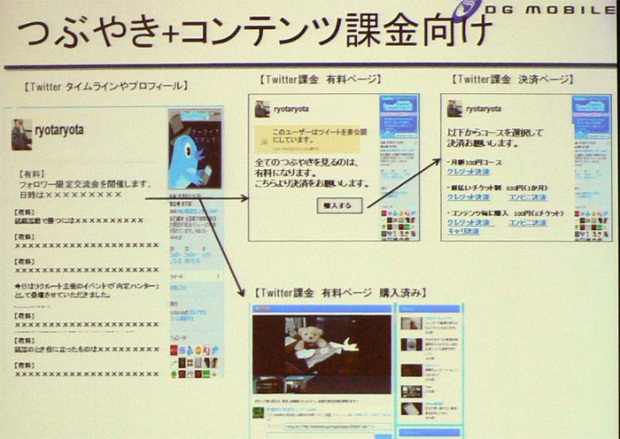
Details are sketchy at this point, but Japanese media are reporting that Twitter is going to introduce a tiered payment model and aims to charge people to view tweets from certain premium Twitter accounts.

Twitter Japan, which is operated under supervision of Twitter investor Digital Garage, launched in April 2008 and boasted display ads right out the gate. At a conference earlier this week, Kenichi Sugi, COO of DG Mobile (a Digital Garage subsidiary), announced that Twitter would now add paid subscription options starting in January 2010, allowing account holders to charge audiences for access to their tweets, more text, images, links to their external websites and so on.

Billing would be done on a monthly basis for a price that ranges from 100 Yen (approx. $1.15) and 1000 Yen (which converts to roughly $11.5). Users will apparently be able to use their credit cards, have their mobile carrier include it in their invoices, or even purchase a prepaid ticket at a convenience store to pay for the premium service. Finally, Twitter will be taking a 30 percent cut on transaction fees.

The assumption is that this model would be fit for account holders who deliver real-time information, news and educational content, and tend to include original photographs, video images and audio in their tweets.

The idea isn’t exactly brand new: Twitter co-founder Biz Stone mentioned earlier this year they were thinking of commercializing accounts as a way to get some revenue out of the popular service. But the surprising part is that people will actually be charged for access to premium accounts, rather than having holders pay for them. At least, in Japan.

If I were a betting man, I’d say this is not something Twitter is going to be rolling out in the rest of the world any time soon though.

(Thanks for the tip, Paul Papadimitriou and ITmedia for the image below – more coverage at The Next Web and Brandrepublic)

Update: TC contributor Serkan Toto (who’s based in Japan) followed up with six reasons why this subscription model might just work out well for Twitter … in Japan.

Update 2: “Misunderstanding”: Twitter Japan Now Says There Won’t Be A Subscription Model
Advertisement
Advertisement

Responses

Comments rss icon

  • Ok so to sum up only rich people can see my twitter account? Bravo!

  • Thanks for the mention, Robin.

    Cheers,

    Paul.

  • You know, sometimes you need to subscribe to view certain blogs (like some artists, etc)

    It’s Japan and they always have a different business model that North Americans find it unbelievable.

    • Seems like Japan is showing the way for the U.S. in terms of business models when it comes to Twitter. This makes sense – Japan has been ahead of the curve in many mobile service areas for years. We’ve followed Japan, Europe & other countries, albeit with our own innovations.

  • I don’t like this one bit!

  • awesome….japanese is so creative

  • Thank you for sharing this information. It will be interesting to see how this model works out and how Twitter will tweak this for North America in a effort to create a sustainable revenue model.

    “THINK, PLAN, EXECUTE!”™ -JaWar

    • you can’t be serious. There is no way you hold the trademark to the saying Think, Plan, Execute. That’s just complete bullshit. I went to your site and is completely bullshit as well. thanks for spamming TC

  • This is a dumb idea; they should instead charge companies to use Twitter (Japan), not charge consumers to read some companies’ mini press releases

    • On the other hand, this IS Japan – the land where EVERYTHINg can be sold if marketed in the right way (ie. by some celebrity). In my opinion, the Japanese are big suckers but if they want to pay for it and DG/Twitter can make money out of it, why not?
      If this business model will work anyway, it is in Japan. Outside the islands, I don’t think this will work at all. Personally, I would never ever pay to read tweets.

    • Actually it is like newspaper, where you pay for contents.

  • I didn’t expect this. So at the same time they’re revealing you could be paying to see tweets, they also offer the opportunity for you to make money if your own tweets are valuable…?

    This could work well for things like our sales leads feed through Twitter. Why shouldn’t people pay for that?

    Ian Hendry
    CEO, WeCanDo.BIZ
    [SPAM LINK REMOVED BY TECHCRUNCH]

  • “people will actually be charged for access to premium accounts, rather than having holders pay for them”
    Content is paid, if you want to see it then pay for it. This model is just like paid membership websites.

  • the only way for twitter to keep life…

  • I wonder when we’ll need to start paying to see TechCrunch’s updates :-)

    Question: Will the user receive any of this revenue?

  • I hope it gets adopted all across twitter. Twitter really needs some $$$ to work on its reliability. Fail whales, lost tweets/ DM’s are not something users of such an immensely popular site want to see.
    It was the need of the hour!

  • LOL .. so people will be paying me when I tell them what I had for breakfast if I were a celebrity .. why dont you add a affiliate product sales model for celebrities as well… GOSH !!

  • I think it can totally work and I thought about this model when I “saw the light” after a blogging summit (see post on http://eurostarclient.com/2009/11/13/twitter-against-twitter/).

    The key is to make the amont fluid and based on real content value. For example I would be happy to subscribe to TechCrunch tweets for 1$ a month and be able to stop whenever I want.

  • Dumb. Might work in Japan but of course it won’t fly here. Why Twitter won’t charge companies to publish instead of Users to read re-hashed content is beyond me.

    It’s far more valuable for companies to pay to reach potentially millions on Twitter (and build their brand and conversation with their consumer) than it is for Users to read (as someone smartly put it above) mini-press releases and tweets that amount to titles with links that point to company blogs at their website.

  • Aint gonna happen! People won’t pay for content they can get elsewhere free!

  • most ridiculous and stupidest idea ever.
    twitter is going to prove that its users are suckers not only willing to keep reading stupid status updates from popular people but also willing to pay for that.
    WTF is going on in tech?

  • It will work in japan and anybody that says otherwise obviously never lived in japan. People do things in group in japan. They thus are fan of people on groups too. Paying to read an idol tweets makes you a member of a select group of “better fan”.

    (oh, and in some case give the illusion to the subscriber that he’ll be more loved by the idol…)

    If you want to make money quick, make an account with the name a VIRTUAL IDOL, and you’ll still get subscribers.

    • People doing things in groups are universal phenomenon. What do we Americans do on Facebook, LinkedIn & MySpace. We love belonging to our circle of friends & staying connected. We’re as good (or bad) as the Japanese. Some smart people are simply taking advantage of this behavior.

  • I don’t understand..Why would brands choose to go premium if they know they will reaching out to lesser people that way?

  • The idea is reasonable and smart. sitting near the sources of information and charging the consumers of them twitter can make money without any interrupt in it’ popular usage model in the beginning. but I think they should apply this model on tweet-level not on the accounts. if a account completely goes under a paid-model it’ followers-potential and natural consumers – suddenly would fall. for the new account the situation would be harder since there is no way to demonstrate themself. applying this model on tweets prevents twitter from becoming the land of holes.

Advertisement

Leave Comment

Commenting Options

Trackback URL
Short URL