
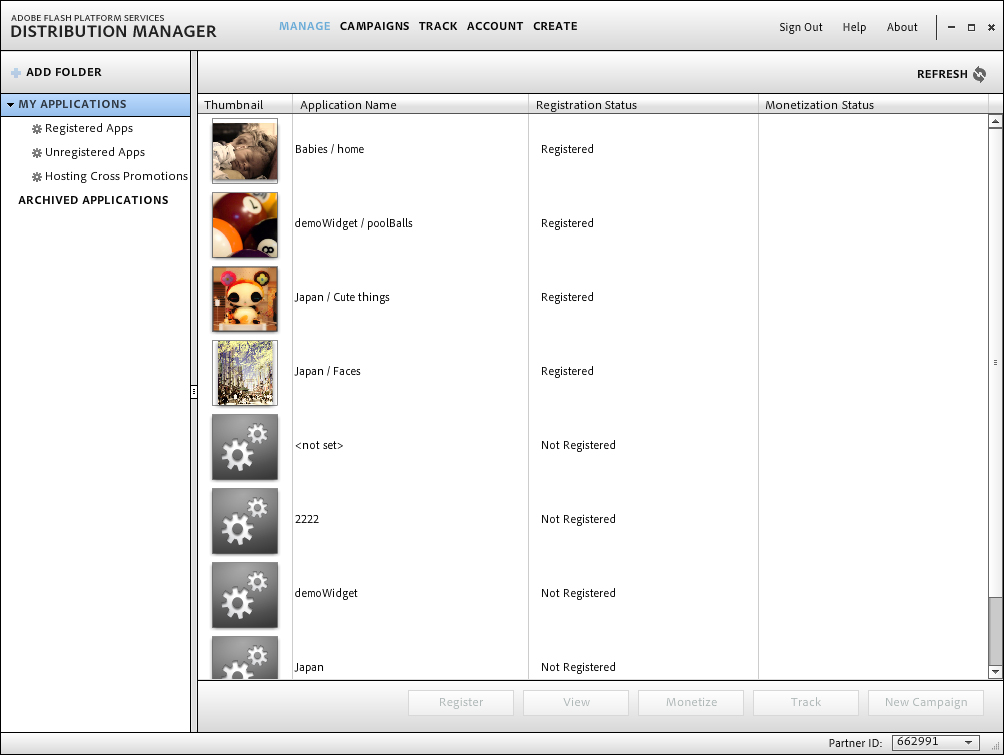
Many of the widgets scattered across the Web are made in Flash, but Adobe doesn’t participate in the widget economy. Today, it is taking a first tentative step towards changing that with the release of a new Distribution Manager for widgets created on the Flash Platform. In addition to making it easier for people to share the widgets across 70 Web and mobile destinations, it will track their usage, and serve as a widget ad network as well.
Adobe is obviously interested in getting into the advertising end of the business, which is why it recently announced it is acquiring Omniture for $1.8 billion. Rather than just getting paid once for the tools to create Web apps and content, it wants to get a piece of those recurring advertising dollars too. The widget distribution play is along the same lines, except that for now Adobe is doing it through a partnership with Gigya, the widget distribution and advertising network. What that means is that any money Adobe makes will be split more ways, but in return it achieves faster entry into the market.
The Distribution Manager allows Flash developers to put a share button on their apps, which opens up a menu giving consumers the option to send that particular widget to Facebook, iGoogle, MySpace, My Yahoo, or various other destinations. It also supports the iPhone, Windows Mobile, and Symbian phones. (Since the iPhone does not yet support Flash, a version of the apps must already be present in the iTunes Store in non-Flash form).
Many advertisers themselves are creating Flash widgets which they are hoping will be spread around virally. They can buy installs on Adobe’s widget network for $1 per install. On the flip side, developers who choose to run these ads will get an effective CPM of $5 (i.e., for every 1,000 impressions). Adobe and Gigya will split whatever is the difference between those two numbers, which will be a function of the exact (undisclosed) revenue share, the number of times an ad widget is installed, and how often it is passed along.
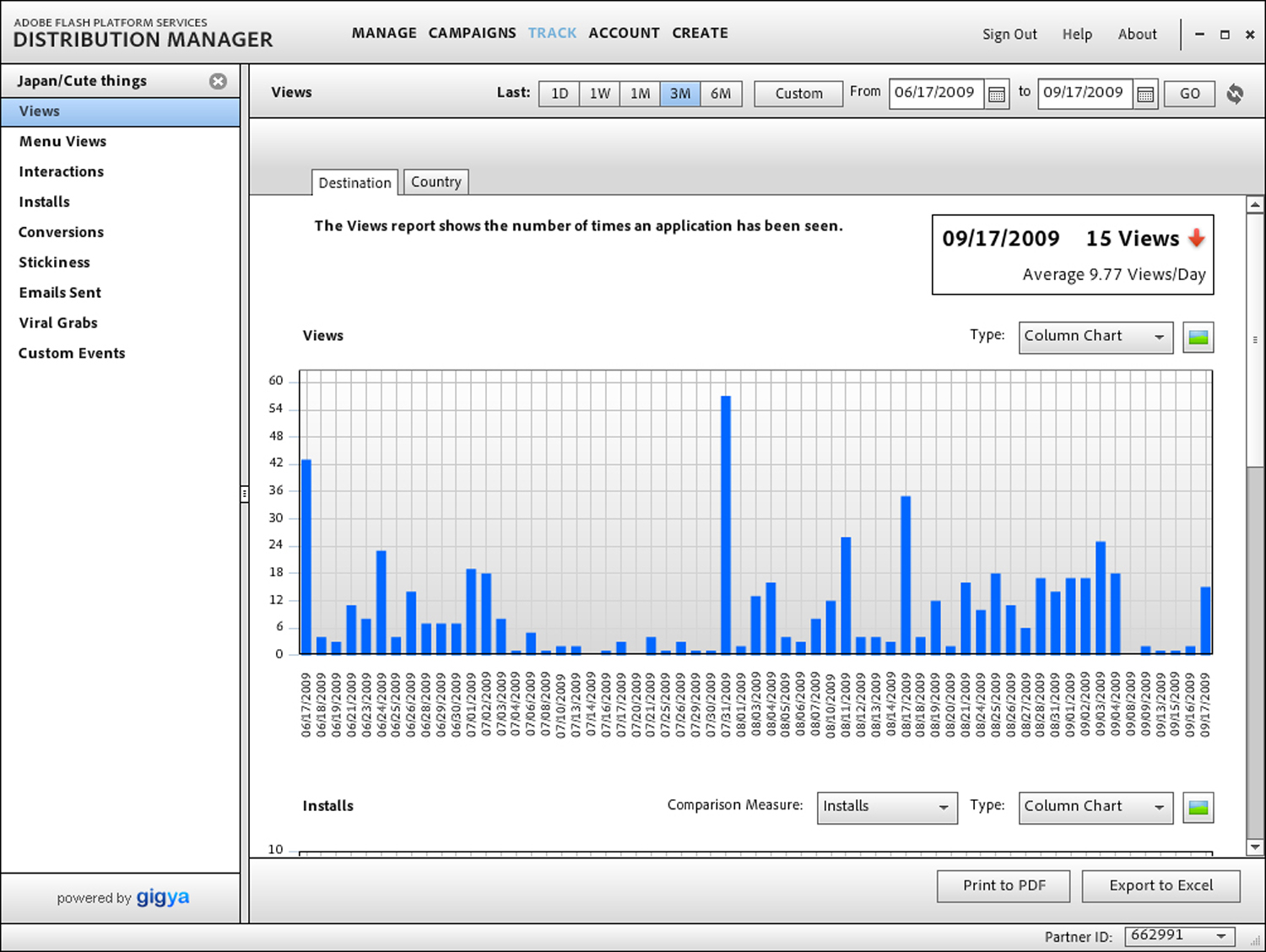
Developers also get an Adobe AIr app which helps them keep track of all of their widgets. They can measure unique users, number of impressions, interaction rates, installs, and how many times it is passed on. The Distribution Manager can also break down installs and usage by social network, device, or country. The next Flash platform service Adobe wants to role out is the ability to develop an app once and distribute it anywhere without re-writing the app.


Adobe AIR not Adobe AIr
This looks pretty cool.
Still dumbfounded by the $1.8B omniture deal,
Nice post Erick
This is so incredibly broken. Adobe is immensely confused about its identity and position in the marketplace. From the perspective of a widget developer, Adobe should put more effort into its product (the entire CS4 platform is weak, full of bugs and uninspired). The bean counting suits seem to have taken over where the inspired developers should be. With any luck they will fail at this in the same way that Photoshop Express and its efforts to sell stock in Bridge have failed. Here is an idea for an exercise -Imagine you have no product franchise and have to develop the tools from scratch. What would you do ? Can you make Flash / Flex sites function like the rest of the web in terms of integration, scale-ability and search-ability? Get back to work on your core products – you are failing.
Wait, you’re saying applications like Photoshop, Illustrator, InDesign, After Effects, Flash, etc are weak? You obviously don’t use any of them. I use the suite on a daily basis and CS4 is great. Sure, adobe has some apps that could be improved (some were acquired from macromedia) but cut them some slack. I also use Apple’s Final Cut Studio and it’s far from perfect.
I’ve used practically every version of all this since 1987. I’ve had a hand in developing the software that drives some of Adobe’s products. You must have the copy that works really well, mine crashes like a blindfolded lobotomized monkey behind the wheel of a bus. The outrage is that the developer of the tools with such a monopoly should not have a vested interest in a distribution channel.
Advertising , yes the most important tool, so why Adobe kept itself away from that. But now its time to see how much it change Adobe’s market. Nice post.
Erick, what does this mean for companies such as http://www.sproutinc.com? Do you think Adobe is planning to roll out its own sophisticated builders? Or will it just buy Sprout and move on?
Widgets?
Kidding. Congrats Gigya! This looks like a real coup!
No surprise here. Thanks Givya, you’ve always stood by our side. Sniffing out where the web is going is not by who you know, it’s What you know, proven in this great post. We’ve been with Gigya for quite a few months now, and it’s no surprise Adobe took into account what smaller developers like us are doing. We’re a branding and widget deployment agency. dmscommunications.info – sorry for the self admonishment here but why not? We’re a Gigya partner and proud of it. If Adobe smartens up and looks to small firms like ours, it’s a no brainer. Exponential.
What the heck are you saying? This makes absolutely no sense in an emphatic sort of way.
We distribute widgets with Gigya. They are a fabulous partner…the best for some types of distribution. However, I would admonish Adobe, as the developer of the tools used by the industry should be separate from any single distribution channel. This is especially true when that tool developer has a virtual monopoly.
What’s next, Flash that defaults to work on IE or Safari? Ad driven Photoshop formats?
Thanks to all the Gigya fans for the kind words, we are excited to bring our technology and services to a wider audience through our relationship with Adobe. Adobe does plan to add additional distribution channels to the distribution manager, this is just the beginning.
Excellent partnership, I now look forward to there Flash Ringtones — lots of growth potential
Widgets man, whod’a thunk?
Congrats to Dave, Rooly and the rest of the Gigya team on a great partnership!
Not to rain on the Adobe parade, but Sprout launched a sophisticated Web Based Flash App Builder two years that includes the Gigya Share features along with Google Analytics, a SDK for integrating Web Services (Twitter, Ribbit, Yahoo Maps, etc), and much more. You don’t need to know how to code, just drag and drop what you want to build.
Examples: http://sproutinc.com/gallery/
Our platform can now be used to customize Facebook Fan Pages, build native Facebook apps, and even Facebook Connect Flash apps.
Check it out at http://sproutbuilder.com There’s a free trial. Please tell us what you think!
I can’t wait to see what Gigya throws out, but Carnet is right, Sproutbuilder is awesome.
Where is the money in this?
Many advertisers themselves are creating Flash widgets which they are hoping will be spread around virally. They can buy installs on Adobe’s widget network for $1 per install. On the flip side, developers who choose to run these ads will get an effective CPM of $5 (i.e., for every 1,000 impressions). Adobe and Gigya will split whatever is the difference between those two numbers, which will be a function of the exact (undisclosed) revenue share, the number of times an ad widget is installed, and how often it is passed along.
Congrats to Rooly and the folks at Gigya, this is a very nice win for them. Adobe, on the other hand, is once again late to the party. In fact, they must not have received the memo that the party is already over. This would have been a great announcement two years ago, but seriously – companies like Sprout have been innovating in this area for years. Get with the program Adobe.
Essentially Adobe is taking what Gigya provides (distribution and analytics), wrapping it up in a dashboard and calling it the Adobe Distribution Platform….nothing new to see here folks!
Sensidea did the same thing and also develop the widgets for clients. Sprout also integrates with Gigya and allows you to build widgets yourself.
This isn’t a major initiative, it’s simply Adobe making it more compelling to use the Flash Platform. Kudos to Adobe for finding yet another way to do push a great platform!
We’ll be checking it out…I just wish you guys bought our dashboard instead
Thanks,
Jaafer
great move by Adobe. perfect for pushing AIR which they have been trying to do. if it works out it gives developers a good choice of a platform to NOT have to deal compatibility issues.
Interesting perspective from the Forrester blog…
http://blogs.forrester.com/product_management/2009/09/adobes-omniture-acquisition-a-ti-perspective.html