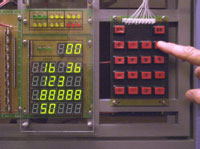
Here’s a project for a rainy year: a DIY Apollo Guidance Computer with 4K RAM, 32K words of ROM, and a 1Mhz processor. One John Pultorak built his own replica in 2004 and released the plans to the world, giving us a glimpse into what was essentially the first pocket calculator on the moon.
The Apollo AGC itself is a piece of computing history, it was developed by the MIT Instrumentation Laboratory and it was a quite amazing piece of hardware in the 1960s. It was the first computer to use integrated circuits (ICs), running at 1 Mhz it offered four 16-bit registers, 4K words of RAM and 32K words of ROM. The AGC mutlitasking operating system was called the EXEC, it was capable of executing up to 8 jobs at a time. The user interface unit was called the DSKY (display/keyboard, pronounced “disky”); an array of numerals and a calculator-style keyboard used by the astronauts to communicate with the computer.
The kit is amazingly complex – and complete – and includes software and hardware designs.