After Google’s earnings call last week, Google’s stock jumped on strong results and comScore’s took a temporary hit. Many analysts and pundits were using comScore’s estimates of flattening paid-click advertising growth at Google to conclude that Google’s overall revenue growth would also be flat. Yet Google reported 42 percent year-over-year revenue growth, and 7 percent quarter-over-quarter revenue growth. In contrast, comscore had estimated 1.8 percent growth in U.S. paid clicks for the quarter.
Since Google gets a huge chunk of its revenues from search ads, there should be some correlation between a slowdown in paid-clicks and a slowdown in overall revenues. Yet as we first noted last February, historically the correlation between comScore’s U.S. paid-click estimates and Google’s actual quarterly results has been hit or miss. This time was no different. During the earnings conference call, CFO George Reyes addresses the paid-clicks issue directly by saying:
Now let’s look at aggregate paid clicks growth. Aggregate paid clicks include clicks related to ads served on Google properties, as well as ads served on our partner sites. Aggregate paid clicks grew approximately 20% over Q1 2007 and approximately 4% over Q4.
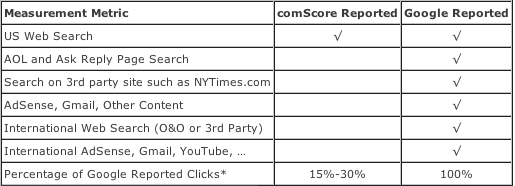
So why the disparity? It turns out many analysts took the comScore data and ran with it, using it incorrectly, as comScore itself points out. As the table above shows, comScore only measures paid clicks on Google search ads in the U.S., which it says accounts for no more than 15 to 30 percent of Google’s total reported clicks. It does not measure global paid clicks (yet). And that’s missing half the story since last quarter 51 percent of Google’s total revenues came from international markets. The comScore figure also doesn’t take into account clicks on AdSense ads that appear on other Websites, or even search ads on AOL and Ask (which are also powered by Google). Nor does it measure clicks on ads on other Google properties such as YouTube or Gmail.
So the comScore figures are an indicator of what is going on with ads on Google search proper, and you can’t really go beyond that. Comscore goes through some math to come up with what it considers a better comparison between its estimates and Google’s’s reported numbers. If you add in comScore’s estimates for AOL and Ask, that would have brought its paid click growth estimate up from 1.8 percent to 5.4 percent. Then, backing out an estimated 18 percent rise in cost-per-click pricing, comScore infers that Google’s actual U.S. paid click growth in the quarter was 10 percent, which narrows the gap considerably. But it is still not perfect.
The lesson here is you cannot take one data point and use that to predict Google’s revenues.