Tens of millions of people have been busy the last few years building Facebook’s most valuable asset – their social graph. As people add friends, and those people add friends, Facebook gets to understand exactly how its users know each other. And as we saw with their “social ads platform,” where users essentially (and sometimes unwittingly) pimp services to each other, it’s not hard to make a little money from data like this.
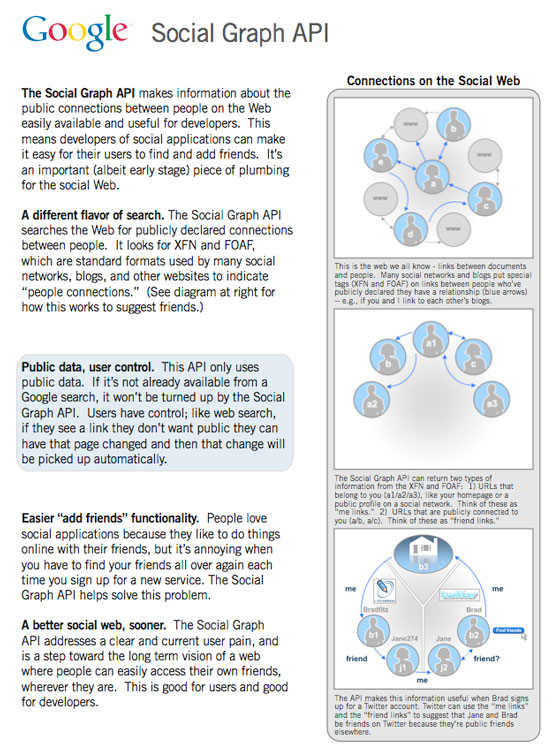
Google, as usual, is not far behind. But they are taking a much different and more open approach to the social graph. Today they are launching the Social Graph API, which will allow third parties to grab social graph data that is produced by every day activities across the web – linking.
Who you are (defined by Flickr, blogs, Twitter and other web services) and who you know, can be determined by data included with links, or in other data included on web pages but not shown in a browser. The two standards around this, XFN and FOAF, provide explicit and public data to Google (and anyone else that looks) on who you are and who you know.
Technically this is pretty simple stuff. Links may contain XFN tags to state a a relationship, such as “me” or “friend.” These are explicit, public statements of relationships and are built in to many web applications, or can simply be added by humans.
Google is taking the resulting data and making it available to third parties, who can build this into their applications (including their Google Open Social applications).
Third parties are already jumping on board. Plaxo is adding the data to their Pulse profile pages to show additional relationships among users.
Companies can use this data as they please. A simple example is to remind a user of their Google-determined friends, and ask them if they want to add them on the new application, too.