
Profile – Zazzle

Michael Arrington

J. Michael Arrington (born March 13, 1970 in Huntington Beach, California) is a serial entrepreneur and the founder of TechCrunch, a blog covering startups and technology news. Arrington attended Claremont McKenna College (BA Economics, 1992) and Stanford Law School (JD, 1995) and practiced as a corporate and securities lawyer at two law firms: O’Melveny & Myers and Wilson Sonsini Goodrich... → Learn More

Wednesday, July 20th, 2005

Company: Zazzle

Launched: 1999 (zazzle.com launched 2003)

Status:
Announced $16m Series A on July 18, 2005

What is it?

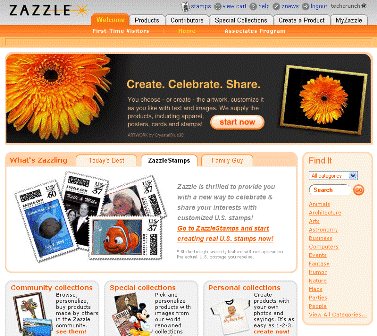
Zazzle let’s customers create customized products, ranging from tshirts to stamps, and sell them on the zazzle website.

In their own words, “Zazzle is the leading customized products marketplace for consumer enthusiasts to share and celebrate their interests by creating apparel, posters, cards, stamps and more. We combine on-demand manufacturing, a robust community, the largest online collection of customizable digital images and unmatched personalization tools to empower you to create your own products. In addition, you can choose to become a contributor by sharing your unique creations in Zazzle’s public galleries. Within these galleries, you can browse, comment and connect with others who share your interests. Contributors also earn royalties every time their creations are purchased by others. For anyone who wishes to create, wear, display, sell or celebrate their interests, Zazzle provides a compelling interactive marketplace to a worldwide audience.” Link
Creating Products:

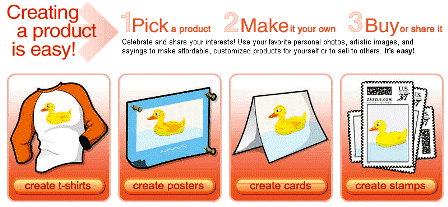
Creating products is a relatively straightforward process of choosing prodcuts (apparel, posters, stamps, etc.), uploading images, and pricing the items. Zazzle claims that they have “over 500,000 totally unique, user-created products, available in billions of variations”. Link
Zazzle Stamps:

Zazzle Stamps is really interesting. Within certain parameters, users can upload their own images, or use stock zazzle images (like disney images), and create actual postage stamps. A sheet of 20 first-class stamps will sell for $16.99, 130% more than “normal” stamps. Zazzle Stamps is possible via a partnership with Pitney Bowes.

FYI, Stamps.com has a similar program and will be partnering with cafepress, a zazzle competitor.


Relevant Links:

About, News, Blog, B2Day, New Persuasion Blog, Alarm:Clock, New Media Musings, Somewhat Frank, RSSWay, Traders Trade, CNET, Ben Barren, Alarm:Clock

Tags: , , , , , , , , ,

Tags:
  • http://blog.programmableweb.com/2008/07/01/data-portability-and-pushability-with-gnip/ Data Portability and Pushability with Gnip

    [...] can be thought of as an ‘activity bridge’ for the social web, or as Nik Cubrilovic of TechCrunchIT put it, doing for social activity what pinging services have done for blogs. Except that the activities [...]

  • bong

    Dosnt this break ssl as now the user will not have end to end security?

  • bong

    Doesn’t this break ssl? There is no end to end security

  • http://www.gnipcentral.com Eric Marcoullier

    Bong, it’s only public data. What do you need ssl for?

  • http://www.rss-blogger.de/blog/2008/07/gnip-zentralbahnhof-oder-universal-ubersetzer-furs-web20/ Gnip – Zentralbahnhof oder Universal-Übersetzer fürs Web2.0? :: RSS Blogger

    [...] techCrunchIT, Ankündigung im März auf techCrunch, Gnip und Twitter, Gnipper im Interview, direkter Link zum Interview (MP3) [...]

  • http://fr.techcrunch.com/2008/07/02/le-fondateur-de-mybloglog-lance-gnip-pour-faciliter-la-portabilite-des-donnees/ TechCrunch en français » Le fondateur de MyBlogLog lance Gnip pour faciliter la portabilité des données

    [...] Vous pouvez découvrir une explication plus complète sur TechCrunchIT [...]

  • http://jp.techcrunch.com/archives/20080701gnip-launches-to-ease-the-strain-on-web-services/ TechCrunch Japanese アーカイブ » ウェブサービスの負担を軽減するGnip

    [...] Gnipの動作に関するより詳しい情報はTechCrunchITの概観記事および、データストリームアグリゲーションに関するこちらの議論を参照して欲しい。 [...]

  • http://bbook.com Dan

    A step up from Mashery I would think, though what will be done about more complex APIs, or private ones? Support?

  • http://www.techcrunchit.com/ Nik Cubrilovic

    Dan: checkout the video we did with them in the next post, we talk about private data and a lot more. I think Mashery is more focused on providing an out-of-the-box dev community platform, whereas Gnip are a proxy for these services.

  • http://www.strategie-influence.com/le-fondateur-de-mybloglog-lance-gnip-pour-faciliter-la-portabilite-des-donnees-961/ Le fondateur de MyBlogLog lance Gnip pour faciliter la portabilité des données

    [...] Vous pouvez découvrir une explication plus complète sur TechCrunchIT [...]

  • http://blog.broadbandmechanics.com/2008/07/blogging-on-july-11-2008 Marc’s Voice » Blog Archive » Blogging on July 11, 2008

    [...] Gnip seems really coolio [...]

  • http://www.DesireMesh.com/2008/09/gnip-making-data-portability-suck-less-or-more-compelling/ Desire Mesh » Blog Archive » GNIP – making data portability suck less (or more compelling?)

    [...] the TechCrunchIT excerpt puts it, the BEFORE GNIP and AFTER GNIP might as well be the difference between NIGHT and DAY: The [...]

  • http://www.insidefacebook.com/2010/06/30/gnip-facebook-apis/ Gnip Standardizes and Reduces Strain on Facebook APIs

    [...] Gnip acts as a proxy between content publishers like Facebook and Flickr, and services that utilize API data, like FriendFeed and Plaxo. Normally, these data consumers would have to expend resources writing and maintaining code to interface with each publisher’s APIs. Then, to keep their own sites up-to-date, they’d have to incessantly query each API to occasionally find a change, such as a new photo being uploaded. Gnip simplifies this process by standardizing many of the most popular APIs so developers only have to support the one overarching Gnip API. Then whenever data changes on the publisher’s site, it notifies Gnip, which then pushes the data to the consuming service, eliminating needless API calls. For a more technical walkthrough of API aggregators, see TechCrunch IT’s in-depth guide to Gnip. [...]

  • http://www.tjoozey.com/2010/06/30/gnip-standardizes-and-reduces-strain-on-facebook-apis/ Gnip Standardizes and Reduces Strain on Facebook APIs » Gnip, Facebook, APIs, Then, Pages, Gnips » App Developer Tyler Johnson Blog – tjoozey.com

    [...] Gnip acts as a proxy between content publishers like Facebook and Flickr, and services that utilize API data, like FriendFeed and Plaxo. Normally, these data consumers would have to expend resources writing and maintaining code to interface with each publisher’s APIs. Then, to keep their own sites up-to-date, they’d have to incessantly query each API to occasionally find a change, such as a new photo being uploaded. Gnip simplifies this process by standardizing many of the most popular APIs so developers only have to support the one overarching Gnip API. Then whenever data changes on the publisher’s site, it notifies Gnip, which then pushes the data to the consuming service, eliminating needless API calls. For a more technical walkthrough of API aggregators, see TechCrunch IT’s in-depth guide to Gnip. [...]

blog comments powered by Disqus